- mev
- navoswap
- price
- routing
- traceability
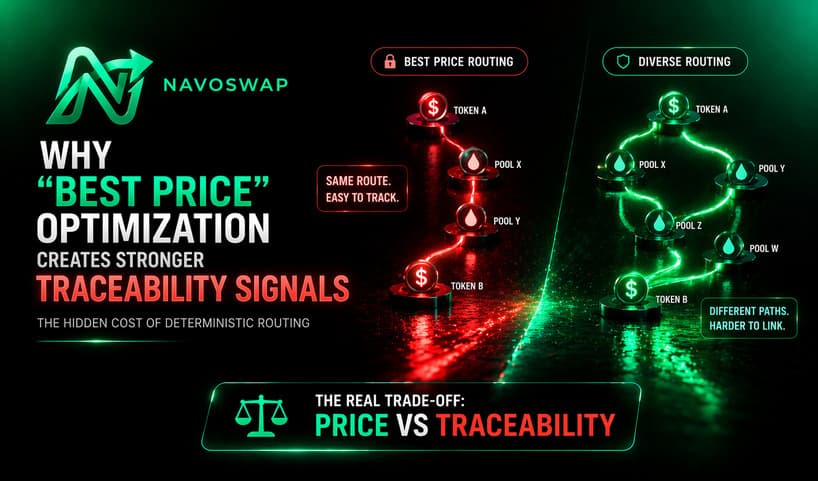
Why “Best Price” Optimization Creates Stronger Traceability Signals
In decentralized finance, “best execution” is almost universally defined as achieving the best price. Aggregators compete on this metric, and users are conditioned to optimize for it. However, this…
Introduction
In decentralized finance, “best execution” is almost universally defined as achieving the best price.
Aggregators compete on this metric, and users are conditioned to optimize for it.
However, this definition ignores a structural consequence:
👉 Price optimization often maximizes traceability
To understand why, we need to examine how routing systems behave under price constraints.
Deterministic Routing Under Optimization
When a system is optimized for best price, it tends to:
- Select the most liquid pools
- Use the shortest execution paths
- Minimize slippage and fees
This creates deterministic routing behavior.
For a given input:
👉 The output path becomes predictable
Repetition Across Users
Because the system is deterministic:
- Multiple users receive similar routing paths
- The same pools are reused
- The same execution patterns repeat
For analytics systems, this creates:
- Highly structured transaction graphs
- Reusable path templates
- Recognizable flow signatures
Path Compression in Analysis
Analytics platforms exploit this determinism by compressing known routing paths into recognizable patterns.
For example:
A specific sequence like:
- Token A → Pool X → Pool Y → Token B
becomes a known routing archetype
When this pattern appears repeatedly:
👉 It becomes easy to identify and classify
Linking Input and Output
Price-optimized routes tend to:
- Minimize intermediate complexity
- Preserve value continuity
- Reduce execution variance
This makes it easier to:
- Match input amounts to output amounts
- Trace asset movement
- Link sender and receiver
The Illusion of Efficiency
From a user perspective:
✔ Better price ✔ Faster execution
From an analytics perspective:
✔ Clear structure ✔ Predictable behavior ✔ High-confidence linkage
NavoSwap’s Structural Difference
NavoSwap challenges this assumption by balancing:
- Price efficiency
- Routing diversity
- Structural complexity
Instead of always selecting the most direct path, it:
- Introduces variation
- Reduces deterministic patterns
- Weakens path predictability
Trade-Off Reframed
The real trade-off is not:
❌ Price vs cost
It is:
✔ Price vs traceability
Conclusion
Best price optimization creates strong structural signals that analytics systems can exploit.
A more advanced approach considers how a transaction is executed — not just what it costs.
NavoSwap is designed to optimize both dimensions.
Related articles

NavoSwap
Non-custodial swaps across many assets—compare routes, tune execution, and trade without giving up custody of your funds.
Swap now