- analytics
- data
- indexing
- lifecycle
- navoswap
The Post-Transaction Lifecycle: How Your Data Is Processed, Stored, and Reinterpreted
Most users view transactions as discrete events: A swap is executed → the process ends. In reality, execution marks the beginning of a **secondary lifecycle** — one where data is continuously proce…
Introduction
Most users view transactions as discrete events:
A swap is executed → the process ends.
In reality, execution marks the beginning of a secondary lifecycle — one where data is continuously processed, enriched, and reinterpreted.
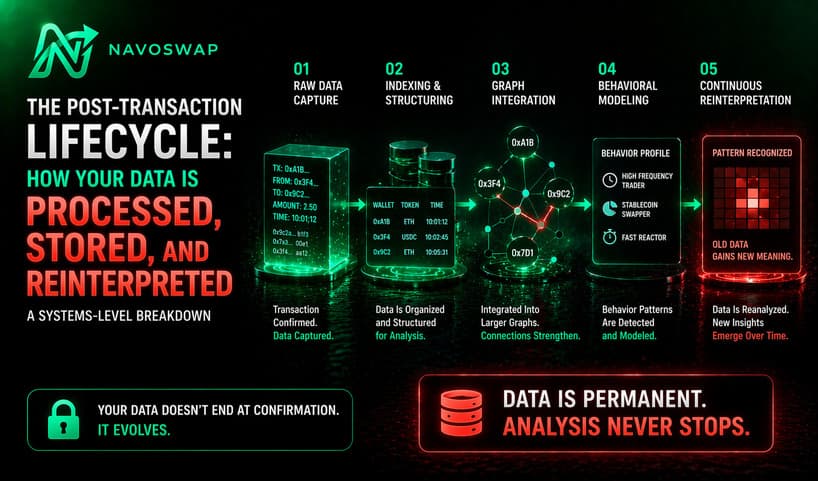
Stage 1: Raw Data Capture
Immediately after confirmation:
- Transaction data is recorded
- Nodes propagate information
- Indexers capture and store events
At this stage, the data is still raw.
Stage 2: Indexing and Structuring
Indexing systems transform raw blockchain data into structured formats:
- Tables of transactions
- Wallet activity histories
- Token movement logs
This enables:
- Querying
- Filtering
- Pattern detection
Stage 3: Graph Integration
Transactions are then integrated into larger graph systems.
Each new transaction:
- Extends existing graphs
- Adds new edges
- Strengthens connections
Over time:
👉 Graph density increases
And dense graphs are easier to analyze.
Stage 4: Behavioral Modeling
Once sufficient data exists, systems begin modeling behavior:
- Trading frequency
- Asset preferences
- Reaction times
This transforms static data into dynamic profiles
Stage 5: Continuous Reinterpretation
Data is not analyzed once — it is re-analyzed continuously.
As new techniques emerge:
- Old transactions gain new meaning
- Previously hidden patterns become visible
The Time Dimension
A key misconception is that:
👉 “Old data becomes irrelevant”
In reality:
- Historical data becomes more valuable
- Long-term patterns become clearer
- Identity confidence increases
NavoSwap’s Implication
Because data is permanently stored and reinterpreted:
👉 The structure of each transaction matters beyond the present moment
NavoSwap focuses on:
- Reducing clarity at the point of execution
- Limiting future interpretability
Conclusion
A transaction is not a moment — it is an input into a long-term analytical system.
Understanding this lifecycle is critical to managing exposure over time.
Related articles

NavoSwap
Non-custodial swaps across many assets—compare routes, tune execution, and trade without giving up custody of your funds.
Swap now