- analytics
- bridges
- multi-chain
- navoswap
- traceability
Why Multi-Chain Activity Increases Traceability: A Systems-Level Analysis
Multi-chain ecosystems are often associated with flexibility and scalability. From a user perspective, moving across chains appears to introduce separation — different networks, different environme…
Introduction
Multi-chain ecosystems are often associated with flexibility and scalability.
From a user perspective, moving across chains appears to introduce separation — different networks, different environments, different contexts.
However, from a systems perspective, multi-chain activity does not fragment identity.
👉 It expands the observable surface area.
The Illusion of Separation
Users assume:
- Different chains = independent environments
- Separate wallets = separate identities
But analytics systems operate above the chain level.
They analyze:
- State transitions
- Asset continuity
- Behavioral consistency
Bridges as Deterministic Connectors
Bridges are not random — they are highly structured systems.
A typical bridge interaction includes:
- Asset lock event (Chain A)
- Validation / relay
- Asset mint/release (Chain B)
This creates:
- A clear input-output relationship
- A measurable time gap
- A consistent asset transformation
The Traceability Mechanism
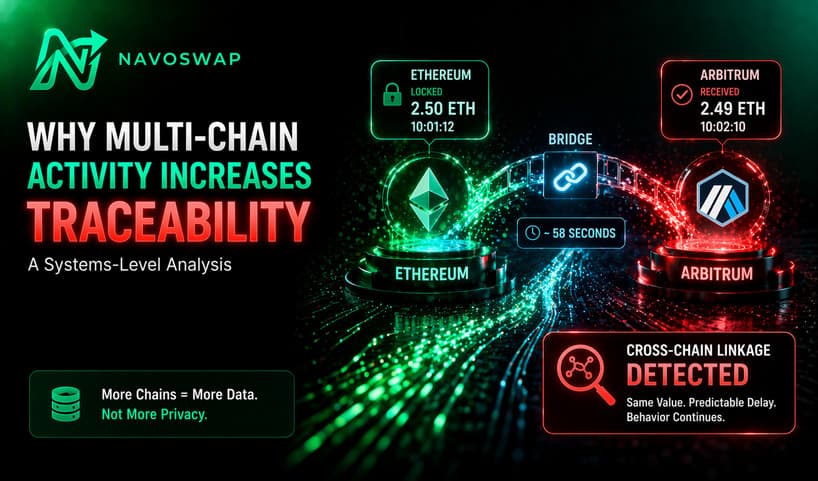
Consider a real scenario:
- User bridges 2.5 ETH
- Within 60 seconds, 2.49 ETH equivalent appears on another chain
- Activity resumes immediately
Even without shared addresses:
👉 The system sees:
- Matching value
- Predictable delay
- Immediate continuation
This forms a cross-chain linkage hypothesis
Behavioral Continuity Across Chains
Users rarely change behavior when switching chains.
They:
- Use the same strategies
- Trade similar assets
- Maintain similar timing
This creates:
- Behavioral invariance
Which is one of the strongest signals in analytics.
Data Expansion Effect
Multi-chain activity increases:
- Number of transactions
- Number of interactions
- Number of observable signals
Instead of reducing traceability, it:
👉 Increases the dataset available for analysis
The Compounding Problem
Each chain adds:
- New graph structures
- Additional timing data
- More behavioral signals
Over time:
👉 Identity confidence increases, not decreases
Why Fragmentation Fails
Splitting activity across:
- Wallets
- Chains
- Protocols
does not eliminate correlation.
It simply:
👉 Requires more sophisticated analysis — which already exists
NavoSwap’s Approach
NavoSwap addresses this at the structural level by:
- Reducing direct cross-chain linkage signals
- Introducing less deterministic routing
- Minimizing clear state transitions
Practical Implication
Users should rethink:
❌ “More chains = more privacy” ✔ “More chains = more data unless structured correctly”
Conclusion
Multi-chain systems do not inherently improve privacy.
They increase complexity — but also increase visibility.
Without careful structuring, they create richer datasets for analysis rather than reducing exposure.
NavoSwap is built to help manage that complexity more effectively.
Related articles

NavoSwap
Non-custodial swaps across many assets—compare routes, tune execution, and trade without giving up custody of your funds.
Swap now