- analytics
- behavior
- interface
- navoswap
- ux
How Interface Design Standardizes Behavior and Strengthens Analytical Models
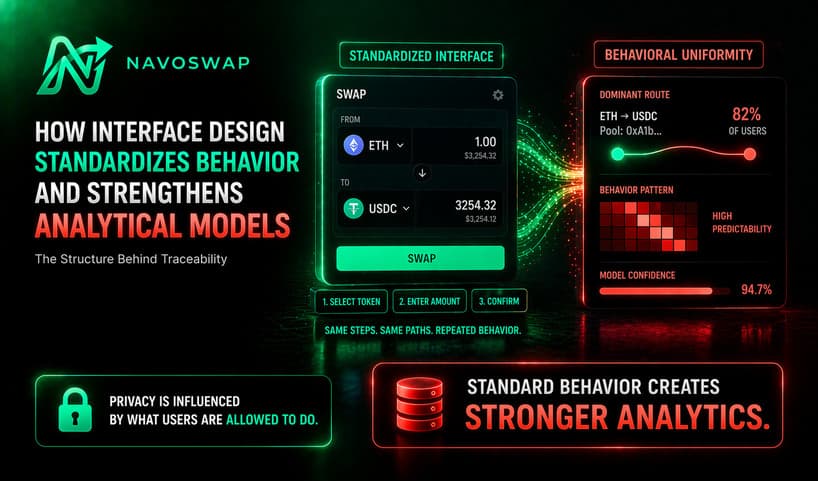
User interfaces are often considered neutral layers — simple tools for interacting with blockchain systems. In reality, they are powerful behavioral constraints. Interfaces do not just enable actio…
Introduction
User interfaces are often considered neutral layers — simple tools for interacting with blockchain systems.
In reality, they are powerful behavioral constraints.
Interfaces do not just enable actions — they shape and standardize them.
This standardization has direct implications for traceability.
Constraint-Driven Behavior
Every interface imposes constraints:
- Limited routing options
- Predefined token pairs
- Fixed execution flows
These constraints reduce user choice space.
Over time:
👉 Reduced choice leads to repeated behavior
Emergence of Behavioral Uniformity
When thousands of users interact with the same interface:
- They follow similar steps
- Use identical routing paths
- Execute transactions in comparable ways
This creates:
👉 Behavioral uniformity at scale
Impact on Analytical Systems
Uniform behavior simplifies analysis.
Instead of modeling thousands of unique patterns, systems can:
- Identify dominant flows
- Categorize users into behavior groups
- Apply template-based tracking
This increases:
- Signal clarity
- Model efficiency
- Tracking accuracy
Feedback Loop Between UI and Analytics
There is a reinforcing loop:
- UI simplifies behavior
- Behavior becomes predictable
- Analytics models improve
- Predictability increases further
Loss of Behavioral Entropy
From a systems perspective:
- Variability = noise
- Uniformity = signal
Interfaces that minimize variability:
👉 Increase signal strength for analysis
NavoSwap’s Design Philosophy
NavoSwap balances:
- Usability
- Flexibility
- Structural diversity
Rather than enforcing rigid execution patterns, it:
- Supports varied routing
- Reduces strict behavioral constraints
- Maintains user simplicity without uniformity
Structural Implication
The key insight:
👉 Privacy is influenced not just by what users do, but by what they are allowed to do
Conclusion
Interface design is not just a UX concern — it is a structural factor in traceability.
Systems that standardize behavior make analysis easier.
NavoSwap is designed to reduce that standardization while preserving usability.
Related articles

NavoSwap
Non-custodial swaps across many assets—compare routes, tune execution, and trade without giving up custody of your funds.
Swap now