- bridges
- correlation
- navoswap
- state-machine
Cross-Chain Bridges as Deterministic State Machines: Why They Strengthen Correlation
Cross-chain bridges are typically described as interoperability tools. From a systems perspective, they are more accurately defined as: 👉 Deterministic state machines This distinction is important…
Introduction
Cross-chain bridges are typically described as interoperability tools.
From a systems perspective, they are more accurately defined as:
👉 Deterministic state machines
This distinction is important because deterministic systems produce predictable and analyzable outputs.
Deterministic Execution Model
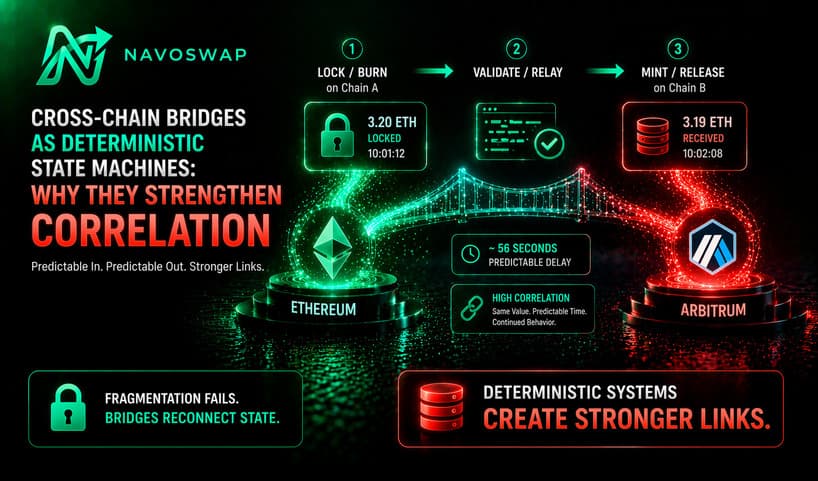
A bridge operation follows a structured sequence:
- Asset is locked or burned on Chain A
- Event is validated or relayed
- Equivalent asset is minted or released on Chain B
Each step is:
- Observable
- Time-bound
- Quantifiable
Input-Output Mapping
Bridges preserve key properties:
- Asset value (minus fees)
- Transaction ordering
- Event timing
This allows analytics systems to construct:
👉 Direct mappings between source and destination states
Reduction of Uncertainty
In analytical systems, uncertainty is the primary obstacle.
Bridges reduce uncertainty by providing:
- Clear entry points
- Clear exit points
- Predictable delays
This increases confidence in correlation models.
Multi-Signal Reinforcement
Bridge-based correlation is strengthened by combining:
- Value similarity
- Timing proximity
- Behavioral continuity
Example:
- 3.2 ETH locked
- 3.19 ETH appears on another chain
- Same trading pattern resumes
This creates a high-confidence linkage.
Structural Weakness of Fragmentation
Users often attempt to fragment activity:
- Multiple wallets
- Multiple chains
However, bridges reconnect these fragments into a continuous state transition.
NavoSwap’s Approach
NavoSwap reduces deterministic correlation by:
- Avoiding simple one-to-one transitions
- Introducing more complex routing paths
- Reducing direct state mapping clarity
Conclusion
Bridges do not obscure activity — they formalize it.
They convert cross-chain movement into structured, analyzable state transitions.
Managing privacy in a multi-chain environment requires addressing this deterministic structure.
Related articles

NavoSwap
Non-custodial swaps across many assets—compare routes, tune execution, and trade without giving up custody of your funds.
Swap now