- intent
- mempool
- mev
- navoswap
- ordering
MEV as an Information Layer: How Transaction Ordering Exposes User Intent
Maximal Extractable Value (MEV) is typically framed as a profit mechanism — an opportunity for validators and searchers to extract value from transaction ordering. This framing is incomplete. MEV i…
Introduction
Maximal Extractable Value (MEV) is typically framed as a profit mechanism — an opportunity for validators and searchers to extract value from transaction ordering.
This framing is incomplete.
MEV is not only an economic layer — it is an information layer.
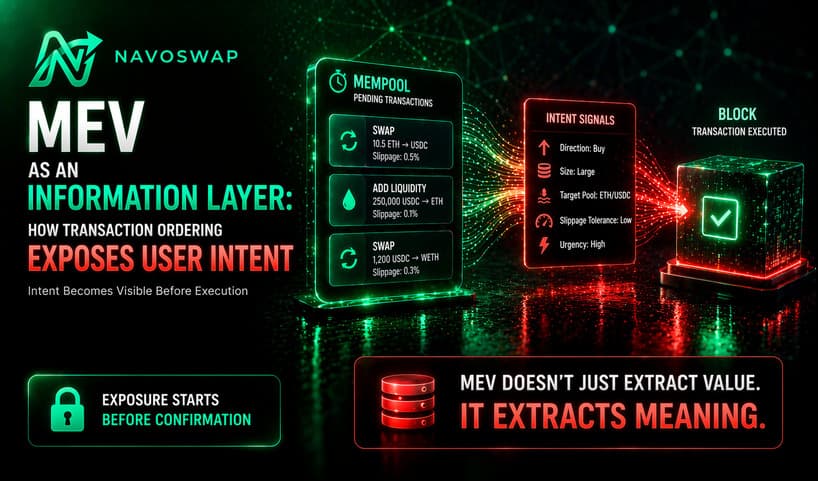
Before transactions are executed, they exist in a state where intent is visible but outcomes are not finalized. This creates a unique environment where user behavior can be observed, interpreted, and exploited.
The Mempool as a Pre-Execution Observatory
In most blockchain systems, transactions enter a public mempool before being included in a block.
This mempool acts as a real-time feed of:
- Pending trades
- Asset movements
- Contract interactions
At this stage:
👉 The transaction is not yet finalized 👉 But the intent is already exposed
Extracting Intent from Structure
A single pending transaction reveals multiple layers of information:
- Direction: buy or sell
- Size: potential market impact
- Target pools: liquidity preference
- Slippage tolerance: urgency
For sophisticated observers, this is enough to reconstruct:
👉 The user’s immediate strategy
Temporal Advantage
MEV actors operate with:
- Low-latency infrastructure
- Direct node access
- Priority transaction submission
This gives them a temporal advantage:
👉 They act before the original transaction is finalized
Repeated Behavior and MEV Targeting
Users who behave consistently:
- Use the same routes
- Trade similar sizes
- Interact with the same pools
become predictable targets.
Over time:
👉 MEV systems do not just react — they anticipate
Ordering as Behavioral Signal
Transaction ordering itself reveals information:
- High gas → urgency
- Low gas → passive execution
- Repeated timing → routine behavior
This creates an additional layer of signal beyond the transaction itself.
Structural Exposure
The key insight:
👉 Exposure begins before confirmation
Even if a transaction is later obfuscated or routed differently:
- The original intent was already visible
- The behavioral signal was already captured
NavoSwap’s Structural Mitigation
NavoSwap reduces exposure at this stage by:
- Avoiding highly predictable execution patterns
- Reducing repeated routing structures
- Supporting more varied transaction flows
This makes:
- Intent harder to infer
- Pre-execution signals less reliable
Conclusion
MEV is not just about extracting value from transactions — it is about extracting meaning from intent.
Understanding this shifts the focus from post-transaction privacy to pre-execution exposure.
NavoSwap is built with this expanded perspective in mind.
Related articles

NavoSwap
Non-custodial swaps across many assets—compare routes, tune execution, and trade without giving up custody of your funds.
Swap now