- analytics
- de-anonymization
- graph
- navoswap
- on-chain
How On-Chain Analytics Actually De-Anonymize Users: A Structural Breakdown
Most discussions around blockchain tracking focus on surface-level ideas: transactions are public, wallets are visible, and activity can be followed. While true, this framing significantly underest…
Introduction
Most discussions around blockchain tracking focus on surface-level ideas: transactions are public, wallets are visible, and activity can be followed.
While true, this framing significantly underestimates how modern analytics systems operate.
In reality, tracking is not about observing individual transactions — it is about reconstructing intent, ownership, and behavior from fragmented data.
To understand how users are de-anonymized, we need to look at the structural process behind on-chain analytics.
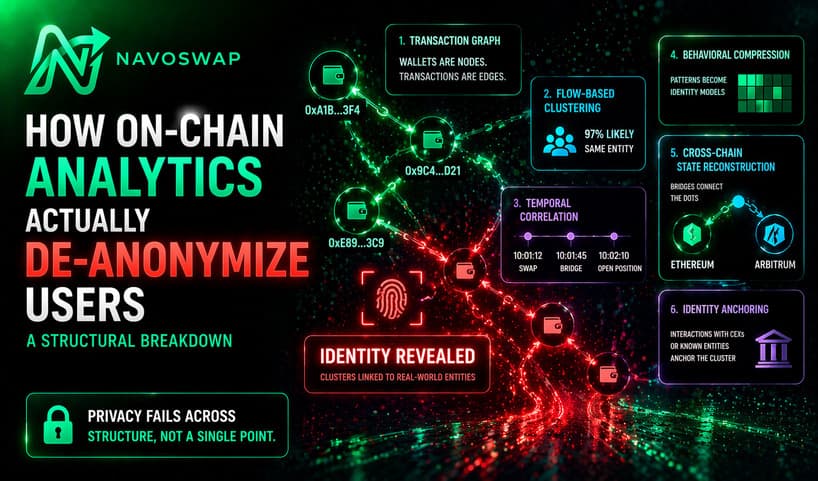
Step 1: Transaction Graph Construction
Every transaction is not treated as an isolated event. Instead, it becomes a node within a directed graph.
In this graph:
- Wallets are nodes
- Transactions are edges
- Asset flows define direction
Over time, a wallet’s activity forms a subgraph — a localized network of interactions.
The key insight:
👉 Individual transactions are weak signals 👉 Graph structures are strong signals
Once enough edges exist, the structure itself becomes identifiable.
Step 2: Flow-Based Clustering
Analytics systems don’t rely on explicit ownership — they infer it.
One of the most effective methods is flow-based clustering.
Example scenario:
- Wallet A sends funds to Wallet B
- Wallet B immediately routes funds to Wallet C
- Wallet C interacts with the same protocol repeatedly
Even if A, B, and C are technically separate wallets, the flow continuity suggests shared control.
Clustering models assign probabilities such as:
“There is a high likelihood these wallets belong to the same entity”
Step 3: Temporal Correlation
Time is one of the most underestimated signals.
Consider:
- A swap occurs at 10:01:12
- A bridge transaction happens at 10:01:45
- A new position is opened at 10:02:10
Individually:
- These events are unrelated
Together:
- They form a temporal chain
Analytics systems exploit:
- Low latency between actions
- Repeated timing intervals
- Consistent reaction speeds
This creates a temporal fingerprint.
Step 4: Behavioral Compression
Once enough data is collected, systems compress behavior into patterns.
For example:
- Always swapping stablecoins → mid-cap tokens
- Consistent transaction size ranges
- Repeated usage of specific liquidity pools
This creates a compressed identity model, where:
The system no longer needs to track every transaction — it only needs to match patterns.
Step 5: Cross-Chain State Reconstruction
Users often assume switching chains breaks tracking.
In practice, it does the opposite.
Bridges create deterministic relationships:
- Asset amount remains consistent
- Timing is tightly coupled
- Entry/exit points are visible
Example:
- 5 ETH bridged from Ethereum
- ~5 ETH equivalent appears on another chain
- Activity resumes within minutes
Even without shared addresses:
👉 The state transition is observable
Step 6: Identity Anchoring
At some point, wallets interact with:
- Centralized exchanges
- Publicly labeled addresses
- Known entities
These interactions act as anchors.
Once anchored:
- Entire clusters can be associated with identity
- Historical data becomes attributable
Where Most Users Miscalculate
Users tend to think:
- “I used a different wallet”
- “I switched chains”
- “I split transactions”
But analytics systems don’t rely on single signals.
They combine:
- Graph structure
- Time
- Behavior
- Flow continuity
👉 Privacy fails not at one point — but across multiple dimensions simultaneously
NavoSwap’s Structural Advantage
NavoSwap does not attempt to “hide” transactions.
Instead, it focuses on weakening the signals that analytics systems depend on:
- Reducing linear flow continuity
- Avoiding simple graph structures
- Introducing more complex routing paths
This makes:
- Clustering less reliable
- Temporal correlation weaker
- Pattern compression harder
Conclusion
On-chain tracking is not about visibility — it is about structure.
The systems that analyze blockchain data are designed to reconstruct meaning from patterns, not just observe transactions.
Improving privacy, therefore, is not about avoiding visibility — it is about disrupting the structure that makes analysis effective.
NavoSwap is built around this principle.
Related articles

NavoSwap
Non-custodial swaps across many assets—compare routes, tune execution, and trade without giving up custody of your funds.
Swap now