- blockchain
- defi
- navoswap
- privacy
- traceability
- transparency
From Transparency to Traceability: When Blockchain Becomes Too Visible
Transparency is one of the foundational principles of blockchain technology. It enables trust, auditability, and decentralization — all wi…
Introduction
Transparency is one of the foundational principles of blockchain technology. It enables trust, auditability, and decentralization — all without relying on centralized intermediaries.
However, transparency has a natural side effect:
👉 Traceability
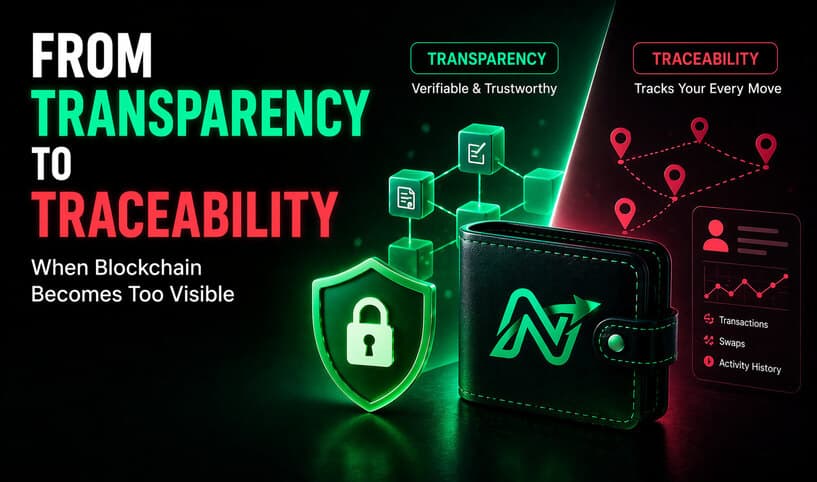
As blockchain adoption increases, the distinction between transparency and traceability becomes increasingly important. While transparency allows systems to be verified, traceability allows user behavior to be tracked.
Understanding where this line is crossed is essential for anyone interacting with decentralized finance.
Transparency: The Intended Design
Transparency in blockchain means:
- All transactions are publicly visible
- Data is verifiable by anyone
- Records are permanent and immutable
This ensures:
- Trustless verification
- Open financial systems
- Accountability
From a system perspective, this is highly valuable.
Traceability: The Unintended Consequence
Traceability occurs when transparency is extended beyond verification into analysis.
Instead of simply viewing transactions, observers begin to:
- Follow transaction flows
- Link wallets together
- Analyze behavior over time
At this stage, transparency evolves into something more powerful — and potentially intrusive.
When Transparency Becomes a Problem
Traceability becomes problematic when:
- Entire transaction histories are easily reconstructed
- Wallets become behaviorally identifiable
- Financial activity becomes predictable
For example:
A user who frequently swaps assets across platforms may unknowingly create a detailed, traceable pattern of behavior.
Over time, this pattern becomes a digital fingerprint.
Long-Term Implications
As traceability increases, so do the risks:
1. Full Activity Mapping
Observers can reconstruct a complete history of wallet interactions.
2. Strategy Exposure
Trading behavior and investment strategies become visible.
3. Reduced Financial Privacy
Users lose control over how their financial data is exposed.
Why Most Users Don’t Notice
Traceability is gradual.
It does not happen in a single transaction — it builds over time through:
- Repeated actions
- Consistent patterns
- Predictable flows
Because of this, many users underestimate their exposure.
The Need for Balance
The goal is not to eliminate transparency — that would undermine blockchain itself.
Instead, the objective is to:
- Preserve verifiability
- Reduce unnecessary traceability
- Improve how transactions are structured
NavoSwap’s Approach
NavoSwap addresses this issue by focusing on transaction structure and routing logic.
Rather than allowing direct, easily traceable flows, the platform:
- Reduces direct wallet-to-wallet linkage
- Improves routing complexity
- Minimizes predictable patterns
This creates a more balanced system — maintaining transparency while reducing excessive traceability.
Conclusion
Transparency is essential — but unchecked traceability introduces risk.
The future of DeFi lies in finding the right balance between:
- Openness
- Privacy
- Usability
NavoSwap is built to support that balance — helping users interact with blockchain systems in a more thoughtful and controlled way.
Related articles

NavoSwap
Non-custodial swaps across many assets—compare routes, tune execution, and trade without giving up custody of your funds.
Swap now